

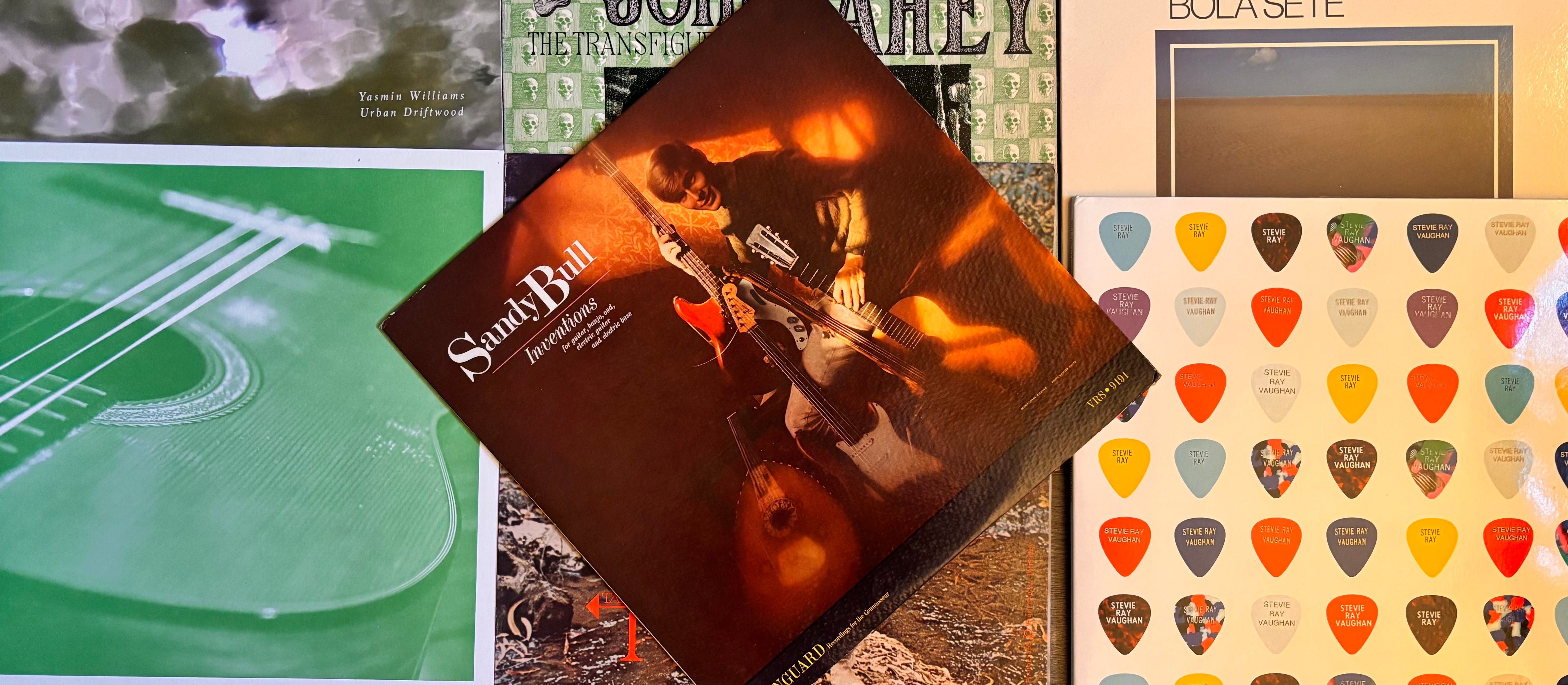
A number of years ago as an experiment I divided my record collection into sections based in part on genre, but also on what I think of as a “listening mode.” I was thinking less about where the records might be filed in a shop, and more about where my head tended to be when I reached for a particular album. So I have one section with darker ambient, prog, post-rock/avant-rock noise-music-type stuff mixed together. These records are rougher and more confrontational than those I filed under “electronic/ambient,” often because they use guitar distortion as a jumping-off point rather than more placid kinds of drone. It’s the difference between Windy & Carl and Yellow Swans—music that I’m likely to be unsettled by rather than lulled into a trance.
I have a section called “Solo Guitar,” which is partly what you’d expect from that designation, in that it includes John Fahey, Robbie Basho, and Jack Rose, as well as latter-day artists like Yasmin Williams. But it goes beyond the post-Fahey scene and includes pedal-steel ambient (Chuck Johnson), free improv (Derek Bailey), and artists who don’t fit easily in any single tradition (Tashi Dorji, Bola Sete). And they’re not all solo records, either. The “listening mode” part of it comes into play because I put these records on knowing I’ll be focusing on how a single player engages with an instrument, which for me is a highly specific kind of attention. I’ve never shown any talent for music, but for a number of years in my younger days I played acoustic guitar regularly, and I have a decent understanding of, as “solo guitar” artist Bill Orcutt put it, how the thing sings.
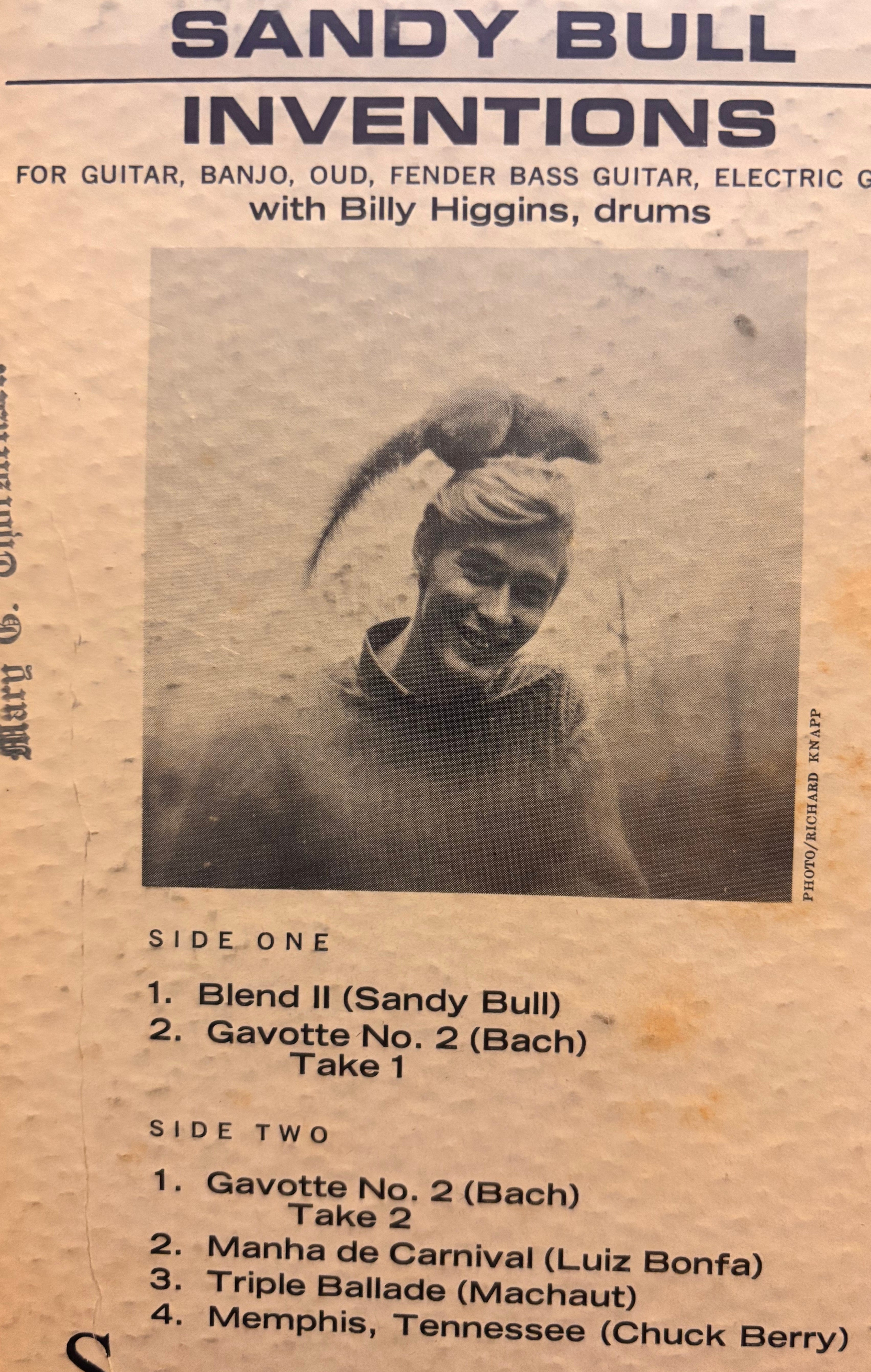
Last year, I added to this section a copy of guitarist Sandy Bull’s 1965 LP Inventions, which I found cheap in the bins at Rocket Number Nine in Kingston. (A typically great obit from Jon Pareles gives an overview of Bull’s difficult life.) The LP is a sequel to his 1963 debut album Fantasias for Guitar and Banjo, and to my ears it’s both stranger and better. Like the earlier record, it pairs pieces from other composers with original material by Bull. Inventions has a deeply weird and wonderful version of Chuck Berry’s “Memphis, Tennessee” that is hard to describe—druggy and psychedelic, though that term for music wasn’t in wide use in 1965, and it has Bull playing multiple parts via overdubbing. It includes a piece from Luiz Bonfá (his LP Luiz Bonfá’s Brazilian Guitar is in my solo guitar section), and I’m guessing that Bull’s full title, Inventions: For Guitar, Banjo, Oud, Fender Bass Guitar, Electric Guitar, may have inspired the title of one of my all-time fave LPs, Manuel Göttsching’s Inventions for Electric Guitar. Both the Bull records include a long, semi-improvised, genre-hopping piece that takes up nearly a full album side, called “Blend” on Fantasias, and “Blend II” on Inventions.
On “Blend II,” Bull plays steel-string acoustic with jazz drummer Billy Higgins, who had by this point played with John Coltrane, Dexter Gordon, Jackie McLean, Thelonious Monk and, most significantly, on nearly all of Ornette Coleman’s earliest records, including 1961’s Free Jazz. He’d also played on Bull’s Fantasias. Though he and Bull are locked in on “Blend II,” I have to imagine this may not have been a particularly challenging date for Higgins, given his presence on some of the most innovative jazz records ever made. Still, his playing adds an important boundary-shifting layer to a track that already has a tremendous amount going on.
During the first four minutes or so of “Blend II,” Bull plays alone, teasing out phrases that preview the directions he’ll be taking once the piece ramps up. The liner notes by Nat Hentoff sent me scurrying off to listen to sources where I could. He writes of Egyptian Nubian composer Hamza El Din (Bull roomed with him for a while), Indian classical musician Ali Akbar Khan, as well as music from Lebanon, North Africa, and Pakistan. He also points to an arrangement of the folk tune “Pretty Polly” by Mike and Pete Seeger. He mentions an Ornette composition but calls it “Lovely Woman” instead of “Lonely,” a mistake that had to sting when he first saw it in print on the back of the album cover that I’m now holding in my hands 61 years later. (A mistake, incidentally, that I’d never even think of pointing out were he still alive—I ask that you extend me the same courtesy when it comes to my many errors.) Hentoff situates the music in the territories where it seems to reside, which is to say that it’s modal with undercurrents of drone.
When I hear Bull improvising while sliding between these North African, Middle Eastern, and South Asian scales, my mind goes to my earliest encounters with distantly related music on guitar, which probably came from listening as a teenager to Jimmy Page on a tune like “Black Mountain Side.” It sounded dark, mysterious, searching, only some of which is inherent in the sound while the rest comes from a Western ear’s learned responses to music of other cultures. Regardless, Bull’s improvisation is amazing and provides something interesting to chew on every few bars, a new melodic wrinkle and scale that gives the piece a different tint. Higgins, meanwhile, grows steadily more energetic, going from marking time to pushing Bull forward, until he glides into a nicely efficient solo that keeps the focus on the pulse.
And then, a couple of minutes later, Bull drops partway into an Appalachian folk tune, which I believe is what Hentoff identifies as the Seeger reference. There’s a two-bar section where he plays a phrase that sits precisely between eastern Kentucky and somewhere on the eastern rim of the Mediterranean, half this and half that, before switching to a jaunty and immediately identifiable North American folk melody. It seems like Bull is teleporting somewhere, viewing the world from a different angle, even though the positions of all the people and objects on that planet haven’t changed. The first time I heard this transition I started laughing to myself, it was such a delightful surprise, and it still gives me a jolt of happiness even after hearing “Blend II” dozens of times. After playing with the melody for a few additional bars, Bull moves on, back into the modes and drones.
Two images came to mind on my first listen to this section, one a distant memory and the other a figment of my imagination. In 1993, I was working on a fishing boat, a factory trawler in the Bering Sea. A guy in the cabin across the hall from me, I feel like his name was Jamie, brought an electric guitar onboard, and I used to see him sitting on his bed with headphones, running through riffs like the opening section of Metallica’s “One.” He told me he’d been in a band with Andrew Wood before Wood founded Mother Love Bone, which I thought was cool.
People came from all over the world to work on the boat. One day, a guy named Minh from Vietnam happened to be walking by while Jamie was jamming away. We watched for a minute and then Minh nodded and extended his hands, a gesture that said, “Can I play it?” (he didn’t speak English). He took the guitar and sat on a bench and started playing what sounded to me like a delicate Vietnamese folk tune. The scales were different, the shape of the melody was unfamiliar, but he played it on the same instrument Jamie had used to bang out Pantera’s “Cowboys from Hell” moments earlier. I felt something shifting, an understanding about the connection between musics that perhaps should have been obvious but somehow hadn’t sunk in.
The second image involves my specific copy of the record, which has a previous owner’s name stamped on it, though I can’t quite make it out. (Sidebar: Sometimes for fun I’ll search a name I find on a used record when it’s distinctive enough. A quick google suggested that a name scrawled on my copy of Roberta Flack’s 1975 LP Feel Like Makin’ Love belongs to a woman in her 70s who lives in Manhattan, and I’m almost sure it’s her, she probably sold it when she bought a copy on CD in 1985. A good social media bit might be to show up at her apartment with the record, say, “Hey, do you want this back?” and then ask her about when she bought the album, what she was doing in her life around that time, and what she thought about it when she listened to it back in the ’70s. I wouldn’t actually do that, but I’m interested.)
Anyway, as I said, I can’t decipher the full name on my copy of Sandy Bull’s Inventions, but the first name is clear: Mary. I’ve tried to imagine what Mary might have felt when encountering this record in 1965. The Vanguard label billed itself as “Recordings for the Connoisseur,” the idea being that buying this LP made your taste more sophisticated than that of someone who bought The Sound of Music or Whipped Cream & Other Delights, both of which sold big around that time.

She liked folk music, obviously, and maybe she enjoyed jazz, too, and got excited about seeing Billy Higgins’ name. Maybe she saw the references from Hentoff’s notes and wondered what it all sounded like. Maybe she frequented coffee shops and some people called her a beatnik, and maybe she risked arrest to smoke marijuana once in a while, particularly when listening to music, because she liked how it let her hear sound differently. And maybe she put the needle down on this record and let the modal shifts and drones carry her away, and then she heard that jaunty bluegrass bit and she laughed, too: All of a sudden, the world seemed smaller and also more alive to possibility—a guy moving his fingers in a certain way on his instrument showed her that what seemed like many was actually one.
Incredible writing about a singular record.
Sandy Bull blows my mind. Steve Gunn’s playing reminds me of him. Also, Raphael Roginski has become one of my fav modern solo guitarists. I think you would like if you haven’t heard. Similar primitive, spartan sound.